


My first art installation
Happy New Beginnings 2026 !
I've always been into visual art and I was commissioned my first installation by @arbrosmoz and @association_lecarrousel I recorded elderly participants testimonies of migration/unrooting/trauma/war stories. Pillars of the association's community. The silent ones.
Photographer @racharhdphoto listened to the oral history recordings and photographed the participants
Now you can walk into the woods of @ville_du_bouscat and listen to the stories, and look at the photos. Make a connection with them, with us.
Thank you @nicolaslepeuple & @johanlescure
David Furlong is a Franco-Mauritian artist, theatre director, and artistic director based in London, whose practice connects theatre, visual arts, and oral history. Founder and artistic director of Exchange Theatre (2006–), he creates multilingual, community-based projects that transform collective memory into artistic material. His long-standing collaboration with Le Caroussel played a decisive role in the emergence of this dual career, opening up a space where his theatrical research extended into documentary and visual installation. His work consistently engages with social realities: from working-class neighborhoods and migrant communities to schools and underrepresented voices.
Summary
With Des Racinés, the leadership of Le Carousel entrusted me with the mission of gathering the words of the community’s founding generations. This process of collecting testimonies became the starting point for the sound and visual installation presented in the Bouscat forest as part of L’Hiver Enchanté. The stories gathered—from the Congo, Syria, and Spain—transform the forest into a living archive of migration and fraternity. The project is both poetic and political: it connects intimate memory with public space and invites the spectator into an experience of walking, listening, and encounter.
Introduction
Des Racinés is an oral‑history installation created by David Furlong with immigrant communities in Bordeaux. Three voices—from the Congo, Syria, and Spain—are broadcast throughout the forest, turning nature into a living archive of migration, memory, and resilience. Extending his theatrical practice into the visual arts, David Furlong weaves together sound, space, and collective storytelling.
Context and Motivation
David Furlong’s practice explores the intersection of collective memory, oral testimony, and artistic creation. In Laïque Cité, he worked with communities to embody fraternity through theatre and video, transforming lived stories into performance and documentary film. That project demonstrated how testimony can become artistic material. Des Racinés extends this methodology into the field of visual arts.
The project originated from a commission by the leadership of Le Carousel, who wished to inscribe the stories of key transmitters of knowledge into an artistic gesture. This approach also draws on my training in oral history with Border Crossings, which strengthened my conviction that oral history can become an artistic medium in its own right. France is shaped by migration and diversity. Oral testimonies—fragile yet powerful—carry identity. By placing them within a natural environment, the project creates a poetic and political gesture: the forest becomes a resonant chamber for voices often absent from institutions.
Artistic Concept
The installation combines oral testimonies with spatial sound design. Visitors walk through the forest and encounter voices broadcast among the trees and clearings. Discreet visual markers (wooden structures, light interventions) guide the audience and anchor the experience within the visual arts. The forest becomes a metaphor for roots and interconnection.
Content
Abraham (Congo): the death of his father, accusations of witchcraft against his mother, dignity and fraternity. A metaphor of the globe and a 1980 Toyota as a symbol of unity.
Christine (Spain/France): daughter of a Republican exile, liberation after Franco’s death, pride in speaking French. A poetic invocation of peace and justice.
Isham (Syria): explosions, fear for his daughter, the tender gesture of the hookah. Escape under gunfire, a soldier covering his passage. The impossibility of return.
Together, these stories form a polyphony of migrant voices, moving from the intimate to the political.
My Journey
A French‑speaking Mauritian artist, exiled and based in London, I have collaborated for several years with Le Carousel in Le Bouscat—an artistic relationship that has profoundly shaped my trajectory and sparked this dual movement between theatre and the visual arts. My work is rooted in collective memory and life stories, giving central space to voices often marginalised. As founder of Exchange Theatre in London (2006–), I first explored this approach through directing and working with actors in multilingual and community‑based theatre creations. In 2015, with Laïque Cité, Le Carousel commissioned my first video creation, this time working directly with participants to explore secularism. This collaboration allowed me to develop a practice that links the collection of oral testimonies to their artistic transformation, moving from the theatrical stage to immersive installation. Laïque Cité took shape as a short documentary film, later presented in visual‑arts exhibitions. In parallel, I developed skills and expertise in gathering testimonies within the field of oral history. I continued this research in the documentary In Exchange (2022), dedicated to migrant artists and their precarious position within the cultural sector.
As my stage work evolved into increasingly meta and collaborative forms (The Cat, The Great Experiment, Noor, Tempests), addressing exile, colonial legacies, and the psychological impact of intolerance, theatre naturally led me toward visual forms onstage. In 2023, I was invited to join Pran Kouraz / Take Courage by Shiraz Bayjoo, created with students from a diverse British public school often distant from access to the arts. This collaboration opened a new chapter: becoming, in turn, using techniques from live theatre, a creator of visual art and sound installation.
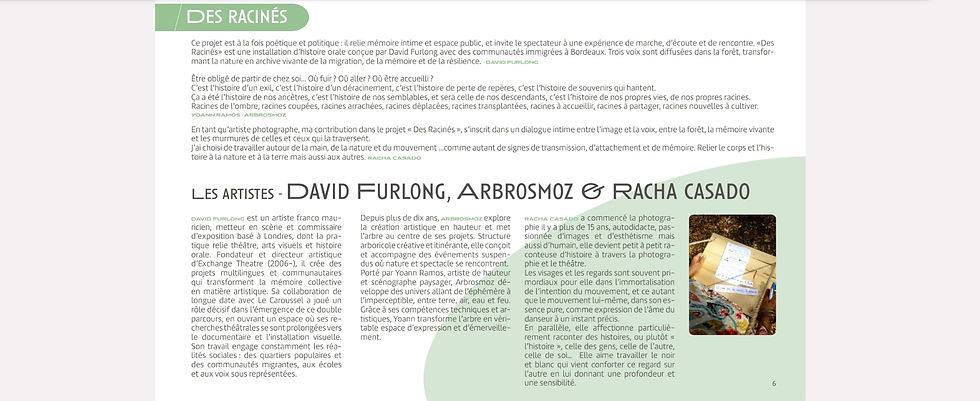
DAVID FURLONG, ARBROSMOZ & RACHA CASADO CREATED WITH THE RESIDENTS
At the crossroads of the poetic and the political, "Des Racinés" blends personal memory and public space. In the forest, three voices of migratory stories transform nature into a living archive of exile, resilience, and roots that are lost, displaced, and reborn. Accompanied by photographic work focusing on the hand, nature, and movement, the photos illustrate gestures that connect body, memory, and transmission.With "Des Racinés" (Rooted Ones), David Furlong collected the stories of founding generations of the Bouscat community. This work of gathering became the starting point for this sound and visual installation. David Furlong: Oral History 'Des Racinés' This project is both poetic and political: it connects personal memory and public space, and invites the viewer to an experience of walking, listening, and encounter. Des Racinés" is an oral history installation conceived by David Furlong with immigrant communities in Bordeaux. Three voices are broadcast in the forest, transforming nature into a living archive of migration, memory, and resilience. David Furlong
Yoan Ramos: Installation Being forced to leave home… Where to flee? Where to go? Where to be welcomed? This is the story of exile, the story of uprooting, the story of losing one's bearings, the story of haunting memories. It was the story of our ancestors, the story of our fellow human beings, and will be the story of our descendants; it is the story of our own lives, of our own roots. Roots of shadow, severed roots, torn roots, displaced roots, transplanted roots, roots to welcome, roots to share, new roots to cultivate.
Yoann Ramos – Arbrosmoz.
Racha Casado: Photographs
As a photographic artist, my contribution to the "Des Racinés" project is part of an intimate dialogue between image and voice, between the forest, living memory, and the whispers of those who pass through it. I chose to work with the hand, nature, and movement… as so many signs of transmission, attachment, and memory. Connecting the body and history to nature and the earth, but also to others.
Racha Casado


Comments